

[Indian] PCB Switch Mode Power Supply Module Board
SMPS - Switch Mode Power Supply Circuits Module
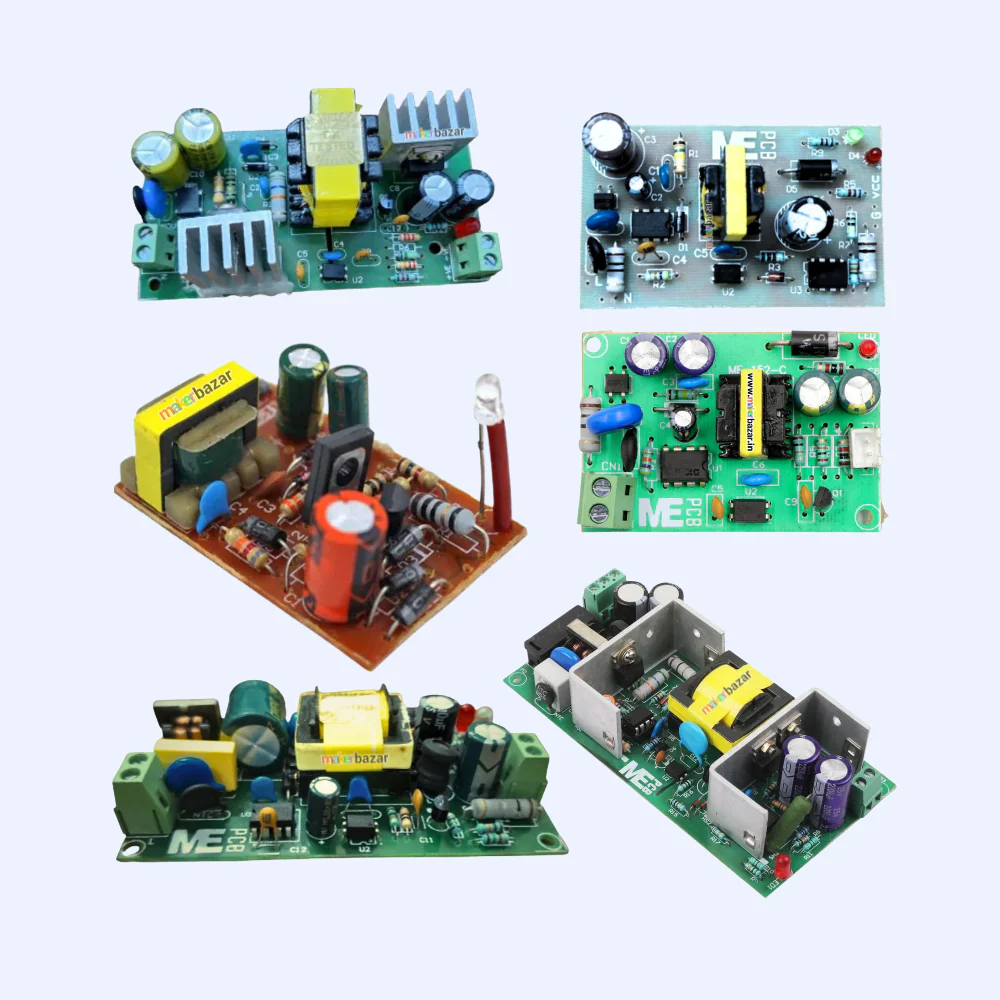
Switch Mode Power Supply (SMPS) circuits are crucial in modern electronics due to their efficiency and compact design. These circuits use a switching regulator to convert electrical power efficiently. Here's a brief overview of the key components and concepts involved in SMPS circuits:
-
Switching Transistor (or MOSFET): Acts as a switch to rapidly turn the current on and off, controlling the energy flow to the output.
-
Inductor: Stores energy when the transistor is on and releases it when it is off. Its primary function is to smooth out the current.
-
Capacitor: Filters out the ripple in the output voltage and stabilizes it. It smooths the voltage to reduce noise.
-
Diode: Provides a path for the current when the transistor is off. It also prevents the current from flowing back into the circuit.
-
Transformer (in some designs): Provides isolation between the input and output, as well as voltage step-up or step-down.
-
Control IC (Integrated Circuit): Regulates the operation of the switching transistor. It monitors the output voltage and adjusts the switching duty cycle accordingly to maintain a stable output.
Original: $0.53
-70%$0.53
$0.16Product Information
Product Information
Shipping & Returns
Shipping & Returns
Description
SMPS - Switch Mode Power Supply Circuits Module
Switch Mode Power Supply (SMPS) circuits are crucial in modern electronics due to their efficiency and compact design. These circuits use a switching regulator to convert electrical power efficiently. Here's a brief overview of the key components and concepts involved in SMPS circuits:
-
Switching Transistor (or MOSFET): Acts as a switch to rapidly turn the current on and off, controlling the energy flow to the output.
-
Inductor: Stores energy when the transistor is on and releases it when it is off. Its primary function is to smooth out the current.
-
Capacitor: Filters out the ripple in the output voltage and stabilizes it. It smooths the voltage to reduce noise.
-
Diode: Provides a path for the current when the transistor is off. It also prevents the current from flowing back into the circuit.
-
Transformer (in some designs): Provides isolation between the input and output, as well as voltage step-up or step-down.
-
Control IC (Integrated Circuit): Regulates the operation of the switching transistor. It monitors the output voltage and adjusts the switching duty cycle accordingly to maintain a stable output.