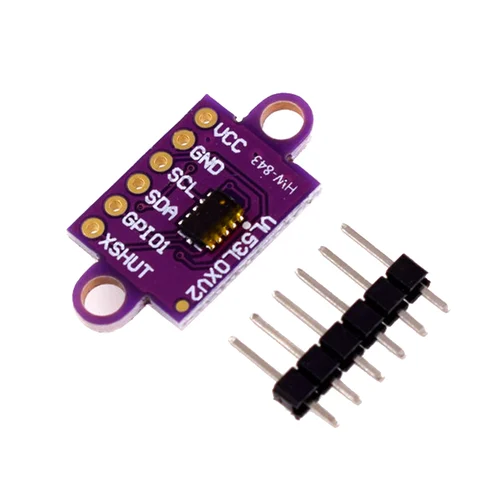

If you want to detect Obstacles with your drones then the VL53L0X TOF-based Distance Laser Lidar/Rangefinder is a quite good solution.No matter If you are a newbie, you can learn more things about this distance sensor.
The VL53L0X is a new generation Time-of-Flight (ToF) laser-ranging module housed in the smallest package on the market today, providing accurate distance measurement whatever the target reflectances, unlike conventional technologies. It can measure absolute distances up to 2m, setting a new benchmark in ranging performance levels, opening the door to various new applications.
The VL53L0X integrates a leading-edge SPAD array (Single Photon Avalanche Diodes) and embeds ST’s second-generation FlightSenseTM patented technology. The VL53L0X’s 940 nm VCSEL emitter (Vertical-Cavity Surface-Emitting Laser), is totally invisible to the human eye, coupled with internal physical infrared filters, enabling longer-ranging distances, higher immunity to ambient light, and better robustness to cover glass optical crosstalk.
Where to Use VL53L0X Sensor?
The VL53L0X sensor got very popular after it was first used in iPhone 7 for 3D imaging and Apple is still using this sensor in its latest mobile phones. It can detect an object within its range even the object’s surface is highly reflective hence measuring distance accurately. It has an integrated Single Photon Avalanche Diodes (SPAD) array. This array is fast and is able to distinguish between different photons with less lag/jitter i.e within a few tens of picoseconds. The time-of-flight technology used in this sensor is ST’s second-gen FlightSense technology. The laser used here is a 940 nm Vertical-Cavity Surface-Emitting Laser (VCSEL) which is invisible and safe for the human eyes. The integrated IR filters enhance the long-range and increase immunity to the ambiance and give good prevention from glass optical crosstalk.
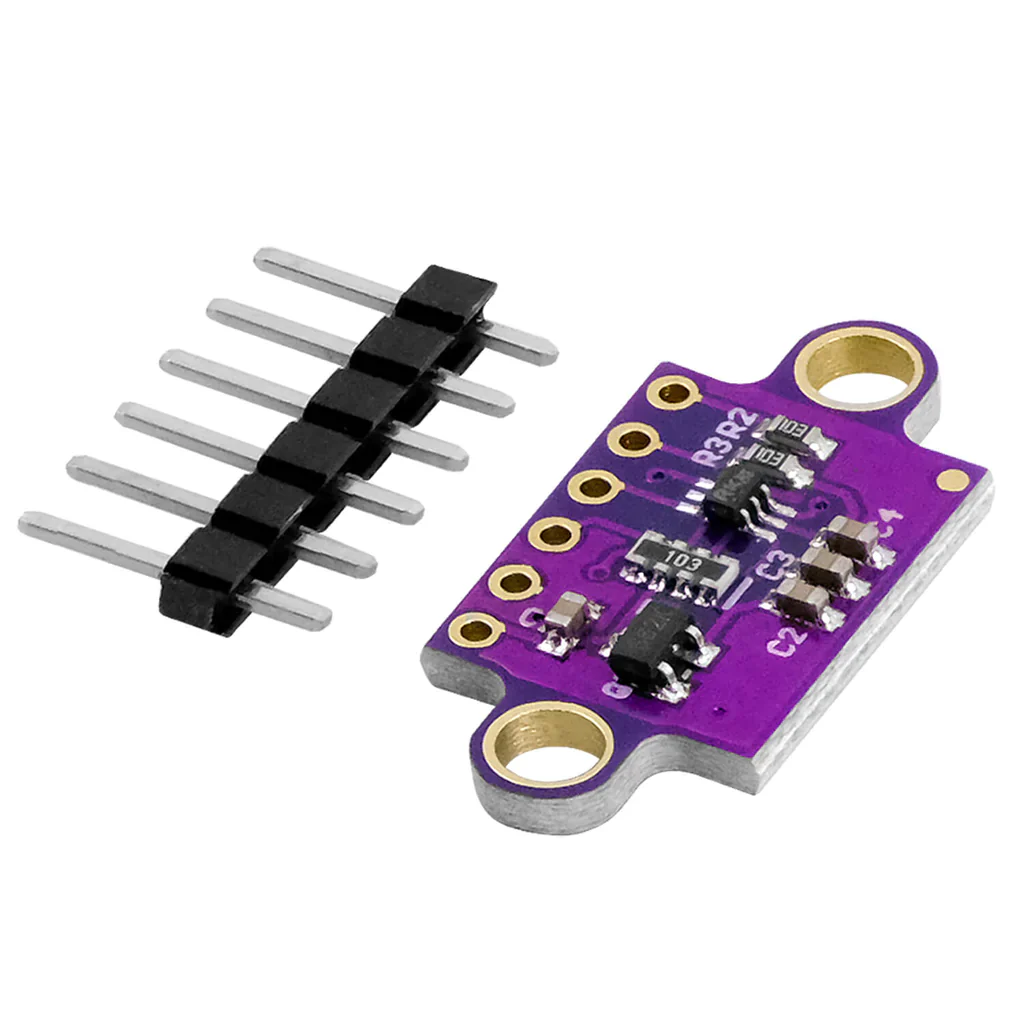
This module has 4 pins VCC, GND, SCL, and SDA. The board has a 2.8V linear regulator and integrated level shifter so, it can bear a voltage in the range of 2.6V to 5.5V. It uses I2C protocol to communicate that’s why Serial Clock Line (SCL) and Serial Data Address (SDA) pins are there to communicate with the microcontroller.
How to Use VL53L0X Sensor
This sensor is easy to use and can be easily incorporated. The module can be powered by a source of 2.6V to 5.5V which is then regulated to 2.8V using the onboard regulator. For communication, you can use the I2C communication pins provided. The sensor can easily be implemented by most of the microcontrollers. More details can be found at the VL53L0X datasheet linked below.
Note: Product may vary in terms of color we will ship it according to availability.
Applications
- Obstacle detection in robotics.
- Hand detection in hand driers, soap dispensers, faucets, etc.
- Gesture recognition in one dimension.
- Widely used in-camera autofocus to enhance the camera performance in low light or fast-moving objects conditions.
- Used as a proximity sensor in many phones.
Connection Diagram of VL53L0X TOF with Arduino:
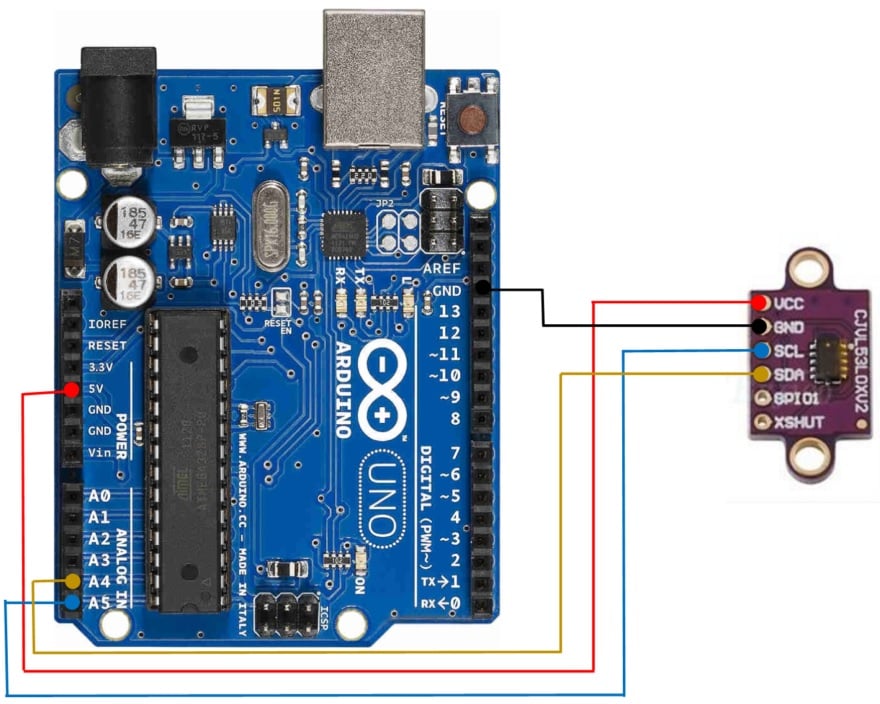
Pin Description:
| Pin Number | Pin Name | Description |
| 1 | VIN | The power supply for the board can be powered by 2.6V to 5.5V |
| 2 | GND | The ground of the module |
| 3 | SCL | Serial Clock Line pin, used for I2C communication |
| 4 | SDA | Serial Data Address pin, used for I2C communication |
Features:
- 940 nm safe and long-ranging laser VCSEL
- In-built 2.8V linear voltage regulator
- Fast and accurate distance ranging. It can measure up to 2m
- Prevents optical cross-talk efficiently.
- Easy integration with microcontrollers because of I2C.